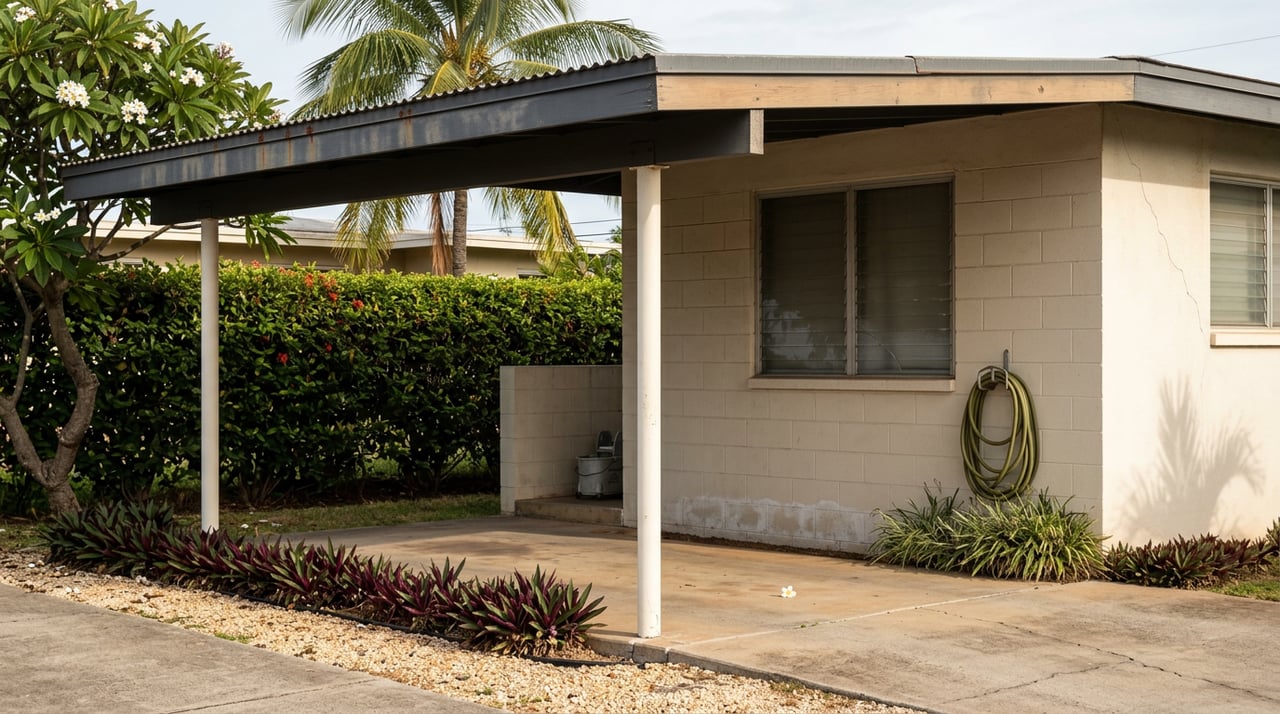
Drive past 425 Kōloa Street on a Tuesday afternoon looking for the Filipino restaurant everyone on the north side has been talking about, and you might miss it entirely. The building looks like exactly what it's always been: boards stacked by the door, wetsuits drying on a rail, the smell of fiberglass and wax drifting out into the parking lot. That's Hi-Tech Surf Sports, and its windsurfing school, HST Windsurfing, has operated out of this same address for years. Walk a few doors down inside the same building, into Suite 104, and you'll find Balai Pata, the Filipino restaurant chef Joey Macadangdang opened as a follow-up to his fast-casual spot Joey's Kitchen, serving dishes like crispy pata and kare-kare stew to a dinner crowd that has no idea a surf shop shares its parking lot.
One business runs on wind. The other runs on reservations. Same street number, same roofline, two completely different clocks.
That contrast is not an oddity. It's the clearest way to understand how Kahului actually works, and once you see it on Kōloa Street, you start noticing it everywhere else in town, from the swap meet that's finished before most people's Saturday begins to a beach that behaves like two different beaches depending on what hour you show up.
The market that closes before the day starts
Every Saturday, from 7 a.m. to 1 p.m., the parking lot behind University of Hawaii Maui College at 310 W Kaʻahumanu Ave turns into the Maui Swap Meet, a market that's been running since the early 1980s and now draws well over a hundred vendors selling produce, flowers, baked goods, and crafts. Regulars know to look for vendors like Aunty Lia's, known for Hawaiian toffee and banana-pineapple bread, tucked among the produce tables and coffee stands.
Here's the part that matters if you live nearby: by the time most people are deciding what to do with their Saturday, the swap meet has already packed up. One o'clock is closing time, not opening time for an afternoon crowd. That timing is exactly why it functions as Kahului's actual town square rather than a tourist stop. It starts before the island's rental cars are even on the road and wraps before the lunch rush hits the resorts thirty minutes away. A market built around a 7 a.m. start and a 1 p.m. finish tells you something about who it's really for.
Kanaha Beach Park keeps two schedules in one afternoon
Ask someone who's never been what Kanaha Beach Park is for, and they'll say windsurfing. That's not wrong, but it's only true for half the day and half the beach.
Kanaha's own windsurfing school schedules its lessons around the wind clock, not the clock, running beginner sessions in the morning when winds are lightest and pushing advanced sessions, including wave sailing and looping, later in the day as the trade winds build. On a strong afternoon, the east end of the park can hold something like a hundred windsurfers in the water at once, boards and sails covering the sand from end to end. That's the image most people carry around of this beach.
But the western stretch of Kanaha runs on a different schedule entirely. It slopes gently, stays calmer, and gets cited as the best swimming beach on the Kahului-Wailuku side of the island, with a swim zone marked off by buoys to keep it separate from the launch areas further east. Locals who want a quiet ocean morning go west and go early. Locals who want to watch the show go east and go after lunch. Two very different versions of the same park, split by geography and by the clock.
| Time of day | What's actually happening | Where |
|---|---|---|
| Morning | Calmer water, lighter wind, family swimming | West end of the park |
| Afternoon | Trade winds build, windsurfers and kiteboarders launch | East end of the park |
There's a third rhythm running underneath both of those. Laeʻula O Kai Canoe Club is headquartered at the park's beachfront pavilion, and paddlers are typically out most mornings regardless of what the wind is doing, a routine that has nothing to do with the windsurfing schedule at all. Add in Kanaha Pond State Wildlife Sanctuary next door, a protected wetland that keeps its own quiet pace no matter how busy the beach gets, and you've got one park running at least three different clocks depending on which corner you're standing in.
What's new on the working streets
Balai Pata isn't the only kitchen opening inside buildings that used to be strictly functional. Momona Bakery & Coffee Shop has built a following for pastries that draw comparisons to the best croissant spots on the island, and Gen Korean BBQ House opened recently in a stretch of Kahului that's better known for auto parts stores and warehouse space than dinner reservations.
None of this is happening in a new development built to look like a lifestyle district. It's happening inside the same industrial-zoned buildings and strip lots that have housed surf shops, tool rentals, and storage units for decades. That's the second version of the two-clock idea: old-economy tenants and new-menu tenants sharing a roofline, with nothing on the outside of the building giving away what's cooking inside.
Two dates that only make sense if you already live here
Not every event on Kahului's calendar is aimed at a visitor. Two coming up in the next month are squarely for the people who already call this town home.
On August 22, 2026, the Maui Arts & Cultural Center hosts its 28th annual Maui Calls, the venue's signature fundraising gala, bringing together food from Maui's own chefs with wine from boutique vintners for a night built around the center's own calendar, not a resort activities desk.
Two weeks later, on September 6, Maui Nui Botanical Garden hosts the Lā ʻUlu Breadfruit Festival at 150 Kanaloa Avenue, right across from War Memorial Stadium, with presentations, food, and craft vendors built entirely around ʻulu, the breadfruit that's been a staple crop across Maui Nui for generations. Neither of these shows up on a typical Maui vacation itinerary. Both show up on the calendars of people who already live here.
The takeaway
If you want to experience Kahului the way it actually runs, stop reading the day off a tourist's clock. Hit the swap meet before the rest of the island is awake. Swim the west end of Kanaha before the wind builds, or head east in the afternoon if you want to watch it. Eat where the building still smells faintly like fiberglass from the shop next door. And put Maui Calls and Lā ʻUlu on your own calendar instead of a hotel concierge's list.
That's been Kahului's clock for forty years. It just took a look inside 425 Kōloa Street to notice it was running two of them at once.
Whether you've called Kahului home for years or you're still learning its rhythms, Rai Morimoto is always glad to talk story about the neighborhood, share what's changing, or answer questions about the local market whenever they come up. Let's Connect.